
Demilec Attic Insulation in Mesquite: A Homeowner’s Guide
Demilec makes both open-cell and closed-cell spray foam, but in Mesquite’s dry heat, the ventilation strategy for your attic decides which one actually performs. Pick wrong and you can trap moisture in a desert house, which sounds impossible until you’ve seen the roof deck sweating behind the wrong foam. This guide maps Demilec’s real product line to what Mesquite attics actually face, so the decision makes sense before anyone hands you a quote.
If you’d rather skip the research and talk it through, call (888) 340-4407. Estimates are free.
Key Takeaways
- Demilec’s two main attic products are Heatlok Soy (closed-cell) and Sealection 500 (open-cell), and they solve different problems.
- Mesquite sits in a hot, dry climate zone where unvented attics built with foam on the roof deck are common and often the better design.
- R-value per inch isn’t the whole story: foam trades some R-value for air-sealing that blown-in fiberglass or cellulose can’t match.
- Demilec’s written warranty and our 365-Day Done Right Promise stack together, so you’re covered twice on the same job.
What’s the difference between Demilec Heatlok Soy and Sealection 500?
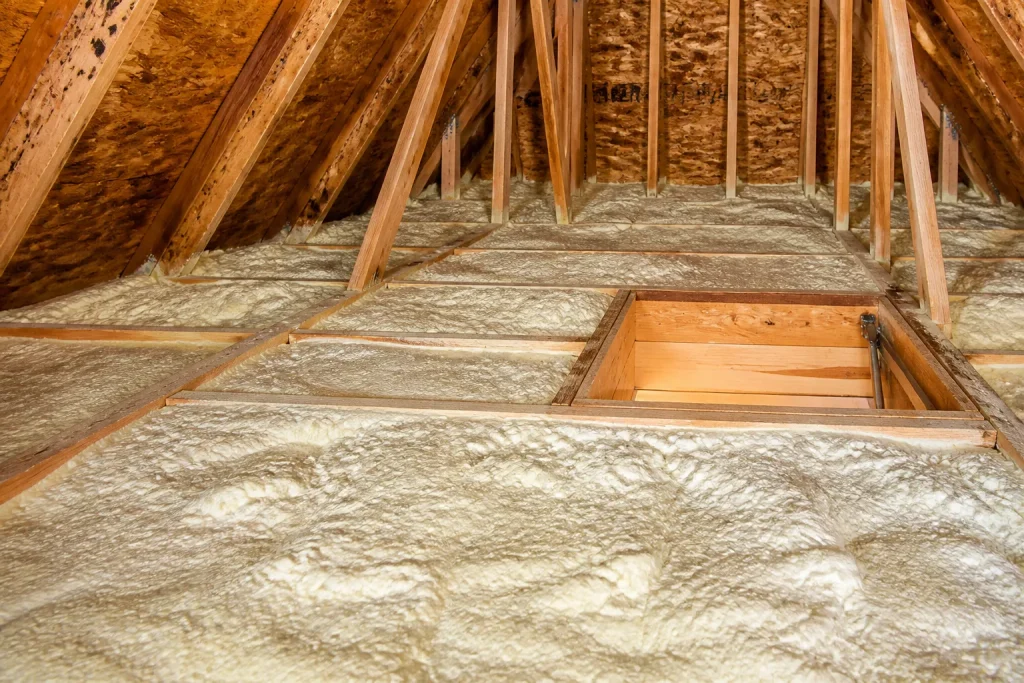
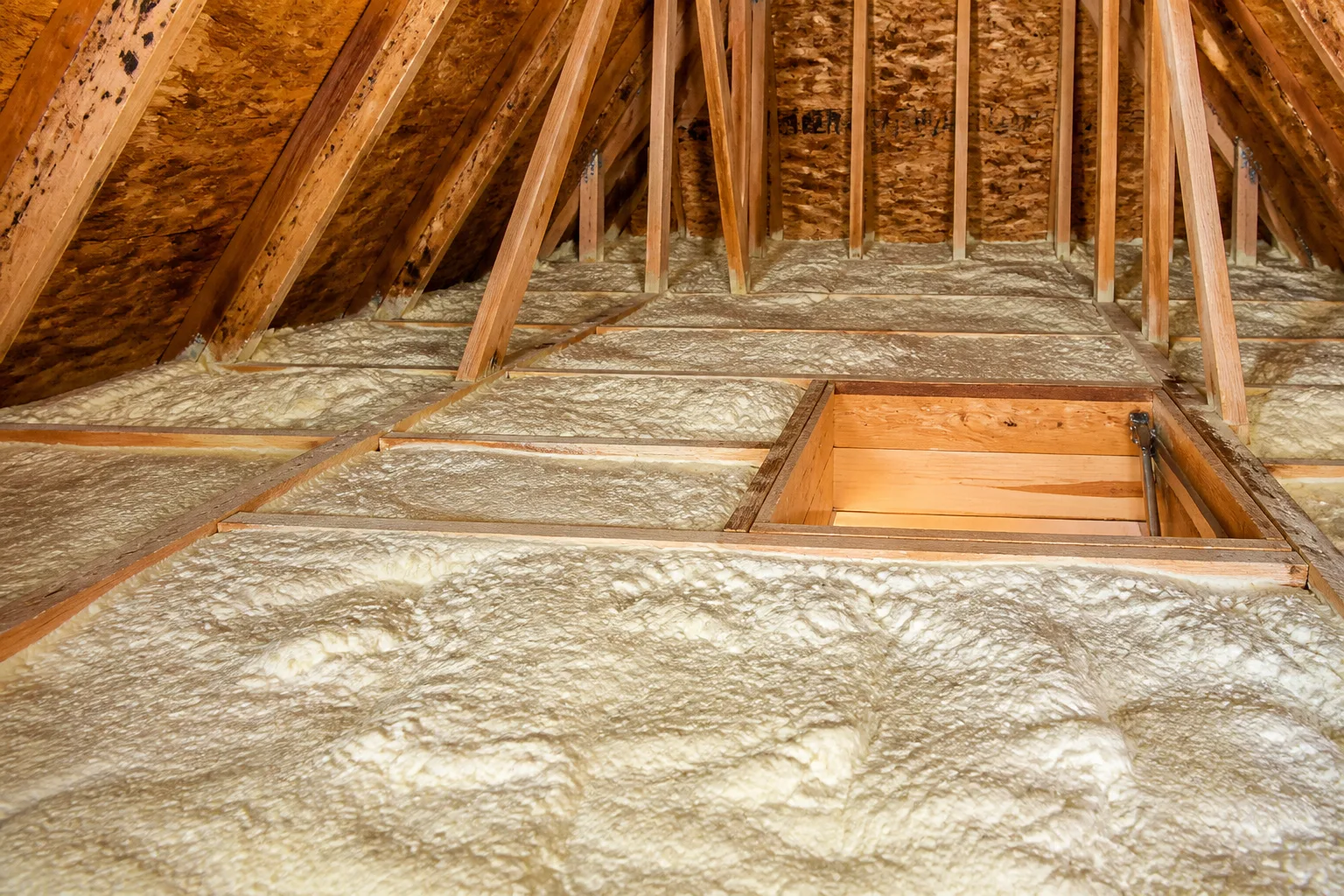
Heatlok Soy is Demilec’s closed-cell spray foam. It goes on as a two-part liquid, expands and cures into a rigid panel that’s roughly 2 lbs per cubic foot, and delivers around R-6.5 to R-7 per inch. It’s also a vapor retarder and adds structural stiffness to whatever it’s sprayed against. Sealection 500 is the open-cell line: it cures softer, lighter (about half a pound per cubic foot), delivers roughly R-3.6 to R-4 per inch, and stays vapor-permeable.
In plain language: Heatlok Soy is denser, higher R-value per inch, and blocks moisture movement. Sealection 500 is lighter, cheaper per board foot, and lets vapor pass through. In Mesquite’s climate the choice usually comes down to one question: is your attic vented or unvented? A vented attic that’s drying to the outside can often use either. An unvented attic where foam sits directly on the roof deck almost always wants the closed-cell profile of Heatlok Soy, because you’re asking the foam to be both insulation and vapor control on the same surface.
- Heatlok Soy (closed-cell): about R-6.5 to R-7 per inch, vapor retarder, adds rigidity, best for roof-deck applications and unvented assemblies.
- Sealection 500 (open-cell): about R-3.6 to R-4 per inch, vapor-permeable, softer, often used on attic floors and vented attics where cost matters.
- Practical Mesquite read: if your attic vents to the outside and stays dry, open-cell can work and often costs less. If it’s unvented or you’re sealing the roof deck, lean closed-cell.
Neither product is “better.” One fits your assembly; the other doesn’t. That’s why we ask about ventilation before we talk about brand.
Why do unvented attics make sense in Mesquite’s dry heat?
An unvented attic, sometimes called a sealed attic or a conditioned attic, is one where the insulation goes on the underside of the roof deck instead of on the attic floor. You’ve moved the thermal boundary from the ceiling plane up to the roofline. The attic itself now lives inside the conditioned envelope, so your HVAC equipment and ductwork up there aren’t baking in 140°F summer air.
In Mesquite, this design shows up more and more, especially on newer construction and retrofits where the homeowner is chasing duct losses. When your ducts run through an unvented attic, the difference is real: you stop cooling a hot box. That’s a Mesquite-specific reason, but the general logic holds anywhere in the Mojave. The catch is that in an unvented assembly, the foam has to control both temperature and moisture. That’s the job Heatlok Soy is built for. Sealection 500 is vapor-permeable by design, which is fine in a vented attic drying to the outside but wrong for a sealed roof deck in this climate.
We’ve seen Mesquite homes where open-cell was sprayed on an unvented roof deck, and the homeowner called us two summers later because the deck was staining. The foam wasn’t defective. It was the wrong foam for the assembly. That’s the mistake this guide is trying to spare you.
How does Demilec’s R-value compare to blown-in?
Blown-in fiberglass or cellulose gets you to a target R-value for less money per square foot, but it takes up a lot more depth to get there. Cellulose lands around R-3.2 to R-3.8 per inch; fiberglass around R-2.5 to R-4.3 depending on the product. To hit R-49 in a Mesquite attic with cellulose, you’re looking at roughly 13 to 15 inches of depth. Heatlok Soy reaches R-49 in about 7 inches. Sealection 500 needs around 12 to 13 inches.
That math matters because Mesquite attics are often tight on headroom, and because every inch of depth eats into storage. But R-value per inch is only half the tradeoff. Blown-in insulation filters air but doesn’t stop it. Spray foam seals. A Demilec job closes the gaps around recessed lights, top plates, and plumbing penetrations that blown-in can’t reach. In a Mesquite attic, air-sealing alone often does as much for your summer comfort as adding R-value, because you’re stopping hot attic air from moving into the living space.
- Cellulose: ~R-3.2 to R-3.8 per inch, cheapest per R, air-filters but doesn’t air-seal.
- Fiberglass blown-in: ~R-2.5 to R-4.3 per inch depending on product, similar air performance to cellulose.
- Demilec Sealection 500 (open-cell): ~R-3.6 to R-4 per inch, plus air-sealing.
- Demilec Heatlok Soy (closed-cell): ~R-6.5 to R-7 per inch, plus air-sealing and vapor control.
If you’re deciding between blown-in and foam on a Mesquite attic, our page on attic insulation in Mesquite walks through the cost and performance tradeoff in more detail.
What does a Demilec installation look like on job day?
Spray foam is a wet process. The crew arrives with proportioners and heated hoses that mix the two parts of the Demilec system at the gun. That equipment is loud. A compressor runs the whole time, so if you’re home, plan on hearing it. Most Mesquite attic jobs run two to three crew members: one on the gun, one feeding hose and staging, one managing overspray and edges. A full attic takes most of a day; a smaller sealed-deck job can wrap in a few hours.
The smell is real but mild: a faint, slightly sweet chemical odor that fades over a few hours to a day. You don’t want to be up there while it’s spraying, and the space is typically off-limits for about 24 hours while the foam cures. In Mesquite’s heat the cure is faster than in cooler climates, which helps, but we still hold the same window because the foam needs to reach full strength before anyone walks on it.
After the spray, the crew trims excess foam flush with framing, sweeps overspray, and hauls out the bagged waste. When we leave, your attic should look like we were never there except for the foam. That’s the same standard across every job we run.
What’s the difference between Demilec’s warranty and a contractor’s guarantee?
Demilec publishes a written limited warranty on its foam products. It covers the material itself, not the installation. If the foam fails because of a manufacturing defect, Demilec’s warranty is what responds. But installation mistakes and workmanship issues fall outside that warranty entirely, and that’s where homeowners get surprised.
That’s the gap our Kingswell Guarantee fills. Every job we do, including every Demilec job, comes with:
- A written price before any work starts, every single time, with no door-step changes.
- A committed arrival window you can plan around.
- A clean job site, left cleaner than we found it.
- A written guarantee on the work itself.
- Our 365-Day Done Right Promise: if something isn’t right within 365 days, we come back and fix it at no charge.
So you end up with two layers of protection. Demilec stands behind the material; we stand behind the installation. For the jobs where foam seals a roof deck, that second layer is the one that catches the problems most likely to actually happen, like a missed corner or a gap around a plumbing stack. If you’re weighing Demilec against the alternatives for a Mesquite home, our page on spray foam insulation in Mesquite breaks down what each approach delivers in this climate.
When should you call a pro on a Demilec job?
Every Demilec job should be done by a trained applicator. Spray foam involves two reactive chemicals mixed under heat and pressure, applied in a confined attic space. Getting the ratio wrong means foam that never fully cures. Getting the ventilation strategy wrong means a roof deck that traps moisture. Getting the prep wrong means foam that looks fine on day one and sags on day 400. None of that is a homeowner task.
If you’ve gotten a Demilec quote and you’re not sure the recommendation matches your attic, that’s also a good time to call for a second opinion. We’ve walked plenty of Mesquite attics where the answer was “you need closed-cell here” and plenty where it was “you actually need blown-in, and I’d save you money by saying so.” We carry the eight leading insulation brands, including Demilec, GreenFiber, and Owens Corning, so we’re not locked into one recommendation.
Related services in Mesquite
If you’re planning attic work, start with our Woolsey Attic Insulation Mesquite home page for what we do and how we work, then explore the insulation pages above so you can compare options before we ever pick up a hose.
The Bottom Line
Demilec gives you two real tools: Heatlok Soy, the closed-cell product that handles roof-deck and unvented applications well, and Sealection 500, the open-cell product that’s often a good fit in vented attics where cost matters. In Mesquite’s dry heat, the ventilation strategy of your attic determines which one actually works, not the price tag. If you’re unsure which side of that line your house sits on, the right answer is an inspection, not a guess.
If you’re in Mesquite and need help deciding, Woolsey Attic Insulation Mesquite offers free estimates. Our technicians have up to 24 years of experience, every job comes with a written price before we start, and the phone is answered by a live person whenever you call. Call (888) 340-4407 for a free estimate.
Frequently Asked Questions
It depends on your attic’s assembly. Demilec foam air-seals in a way blown-in can’t, which matters more in a hot desert climate where hot attic air leaking into the house drives summer cooling bills. But blown-in reaches a target R-value for less money. If your attic vents well and you’re on a tighter budget, blown-in is often the right call. If it’s unvented or you’re sealing the roof deck, Demilec closed-cell is the right fit. Call (888) 340-4407 for an exact quote on either path.
No. Demilec systems require two-part proportioning equipment, heated hoses, and proper PPE. Homeowner kits sold elsewhere are a different product, not the same formulation, and won’t match Demilec’s published warranty. Call (888) 340-4407 and we’ll scope your attic for a professional install.
No. Demilec’s warranty covers the material. Installation and workmanship are the contractor’s responsibility. That’s why every Woolsey job comes with the Kingswell Guarantee plus our 365-Day Done Right Promise, so the installation side is covered in writing. Call (888) 340-4407 to see the guarantee before you commit.
Plan on about 24 hours. The foam needs to reach full cure before anyone walks on it, and ventilation of the space during that window matters. In Mesquite’s heat the cure runs faster, but we hold the same 24-hour window on every job because it’s the right number, not the fastest one. Call (888) 340-4407 for a job-day walkthrough.
Written by the team at Woolsey Attic Insulation Mesquite.
Need Insulation Help?
Call Woolsey Attic Insulation Mesquite - licensed & insured, here with fast after-hours help in Mesquite.
(888) 340-4407